Generative AI can design and create entirely new content, such as text, images, sounds, and 3D models. Generative AI goes beyond traditional AI that focuses on classification or prediction. It explains and then generates new content based on pattern recognition of data.
Smart Tech Guru examines how these systems change all of our relationships to the tools we use. If you are interested in the systems of power that surround us, read our recent blog on the Ethics of Artificial Intelligence.
One of the latest AI innovations is the versatile generative AI technology, which powers everything from AI chatbots to content creation tools.
How Generative AI Works – The Core Mechanism
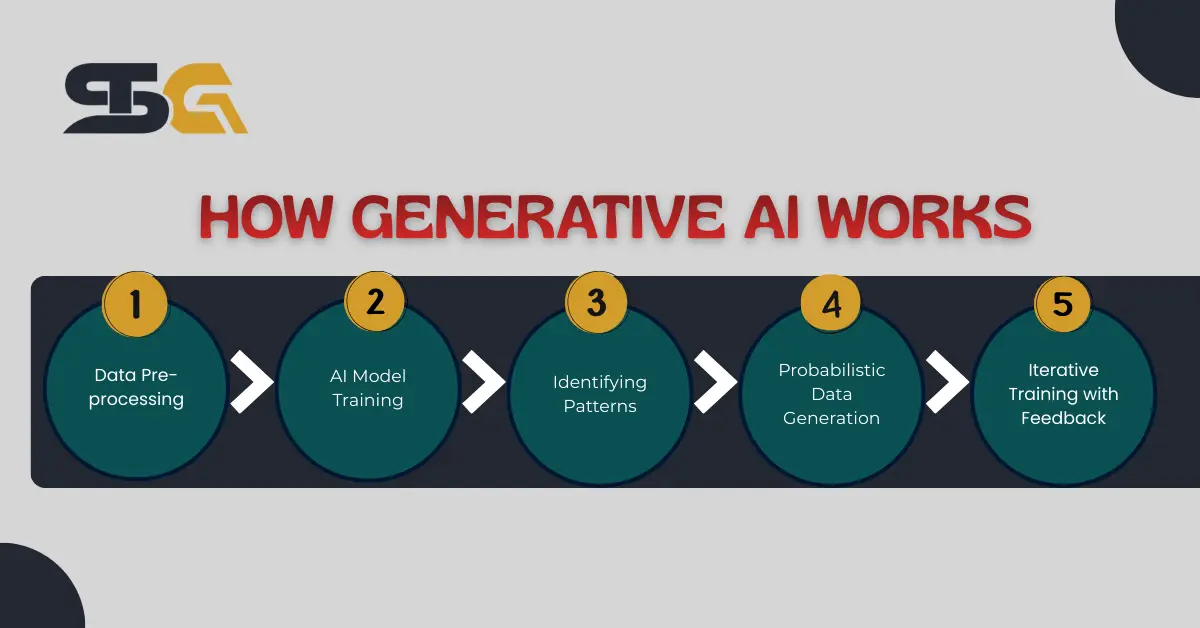
At its heart, generative AI is a probabilistic prediction machine. Here’s the step-by-step process:
- Data Gathering and Training: AI systems are trained using vast amounts of data, such as text, images, and audio.
- Pattern Recognition: Through machine learning, it identifies features and structures within the data.
- Generation Through Sampling: With the data it was trained on, the model is able to create outputs by predicting the next likely word, pixel, or sound.
- Refinement: Outputs are further adjusted to improve coherence and overall quality.
For instance, AI tools like the Google Gemini AI app use this approach to generate text, images, and even answer questions in real-time.
Key Technologies Behind Generative AI
Generative AI relies on several foundational technologies:
- Neural Networks: Modelled after the human brain, these systems take inputs and produce outputs from interlaced nodes that are organized in various layers.
- Word Embedding or Vectors: AI systems “understand” networks by converting each piece of text or data into a numerical representation.
- Transformers and Self-Attention: Self-attention Transformers allow models to streamline the processing of multiple data points by concentrating on the data that is most relevant to the goal.
These technologies together make generative AI capable of producing high-quality content across many applications.
Popular Types of Generative AI Models
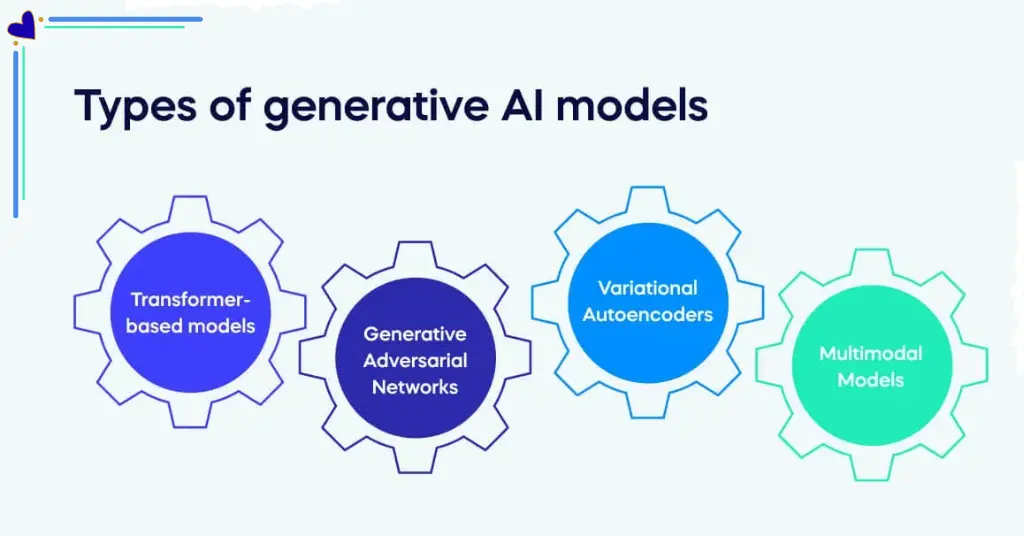
Generative Adversarial Networks (GANs)
GANs consist of two neural networks working in competition:
- Generator: Creates data (like an image)
- Discriminator: Determines if the data is real or generated
Over time, the generator improves, producing highly realistic outputs.
Variational Autoencoders (VAEs)
VAEs produce representations of data and are able to recreate them. While they may be generating less detailed content than GANs, they are typically faster.
Diffusion Models
Diffusion models have gained popularity for generating AI art, particularly for producing detailed and realistic images by adding noise and learning how to undo that.
Applications of Generative AI
Generative AI is already transforming industries:
- Content Generation: Articles, texts, images, music, videos, etc.
- Marketing and Personalization: Generation of ads, customized recommendations of products
- Research and Health: Imaging, diagnostics, simulations, etc.
- Entertainment and Gaming: Generation of realistic characters, virtual worlds, and storylines.
Check out Technology Trends 2025 for insights on how generative AI is shaping the future of innovation.
Benefits and Challenges
Benefits:
- Enhances creativity
- Generated new insights from vast datasets
- Automates repetitive tasks
- Speeds up content creation
Challenges:
- Ethical misuse and bias
- Computing resources are needed
- The training data determines quality
- Some models are slow to generate results
For a deeper dive into ethical considerations, see our blog on Ethics of Artificial Intelligence.
The Future of Generative AI
The future of generative AI is bright. Expect to see:
- Multimodal AI: Combining text, images, and video
- AI-assisted creativity: Helping humans brainstorm and design
- Real-time AI generation: Faster, more accurate outputs for practical applications
Staying updated with these trends is crucial for beginners and professionals alike; that’s why Smartech Guru covers the latest in AI and emerging technology.
FAQs
1. What is generative AI in simple words?
In simple terms, generative AI is a model of artificial intelligence that creates all-new text, images, sounds, or videos just based on what it has learned from existing missions. It produces original information and doesn’t analyze the data it already has; this leaves it free to generate all kinds of new works which are new to both speaker and listener alike.
2. How does generative AI differ from traditional AI?
Traditional AI is still based on predicting or classifying data types, like spam email detection and future patterns in data. Generative AI, however, is most groundbreaking in that it creates innovations without borders between how humans can use it and which computers will one day be able to understand as well. It can generate stories, make images, and even compose music.
3. What are the main types of generative AI models?
Generative AI models come in three varieties-their layout, purpose and style all differ. There are Generative Adversarial Networks (GANs), Variational Autoencoders (VAEs), and diffusion models. Each model has a unique approach to learning their techniques, hardware, and also conclusions present a variety of natural scenes or objects in unique ways, depending on the subject.
4. Where is generative AI used in real life?
Generative AI is used to generate content, such as writing articles and making images, producing music, and making movies. It is also applied in marketing for personalized recommendations, in gaming for lifelike virtual worlds, and in healthcare involving medical image analysis and research. In addition, it features diverse conversational AI tools like ChatGPT and Google Gemini AI apps.
5. What are the ethical challenges of generative AI?
There are some ethical issues with generative AI, such as bias, misuse with deepfakes, data privacy and no accountability for the outputs it provides. In order to reduce harm done by these products, responsible use and oversight are essential to maintain trust.
6. What is the 30% rule for AI?
When referring to AI systems, the 30% rule means that they can only complete 30% of a task on their own risk, with people needed to pick up the slack and ensure tasks are done with the quality and attention to detail desired. In other words, machines can only act as complements to human beings for certain kinds of work. This rule highlights the importance of collaboration between humans and AI.
7. How is GenAI different from ChatGPT?
Generative AI (GenAI) represents a broad category of equipment that can produce content. ChatGPT, specifically a large language model General Textual Response Generation ChatGPT serving as an example of GenAI applied to chat-based functions, In grammatically correct overall. However, while at the same time delivering text that sounds like English dialogue.
8. Does Elon Musk still own OpenAI?
No, there is no longer ownership of OpenAI by Elon Musk. OpenAI has a different setup, and that message. The organization has its concrete corporate partnership and investor funding to thank for its survival.
9. Which country is number one in AI?
The United States is considered to be the world leader in AI development, Research and application, with China being its closest rival in terms of innovation, funding and deployment of technologies.
10. What is an example of generative AI?
Generative AI includes tools such as ChatGPT, DALL·E, music generators, and other applications that assist users with technologies such as Google Gemini AI, where the AI is trained to generate original content.
Conclusion
Generative AI has the potential to change the way we produce and use the content we produce. Once users understand how to use generative AI, the possible uses and difficulties that they may face become a reality.
For the latest pieces, visit Smart Tech Guru to learn about AI and innovation and visit our segment on AI and Emerging Technologies.