Technology is changing faster than ever before. Every year, new ideas move from research labs into real life, reshaping how people work, communicate, and live. In 2025, we are entering a phase where artificial intelligence, renewable energy, biotechnology, and smart connectivity are driving a global wave of innovation.
These emerging technologies are not only creating new opportunities but also redefining entire industries. From healthcare to business and from education to energy, digital transformation is everywhere.
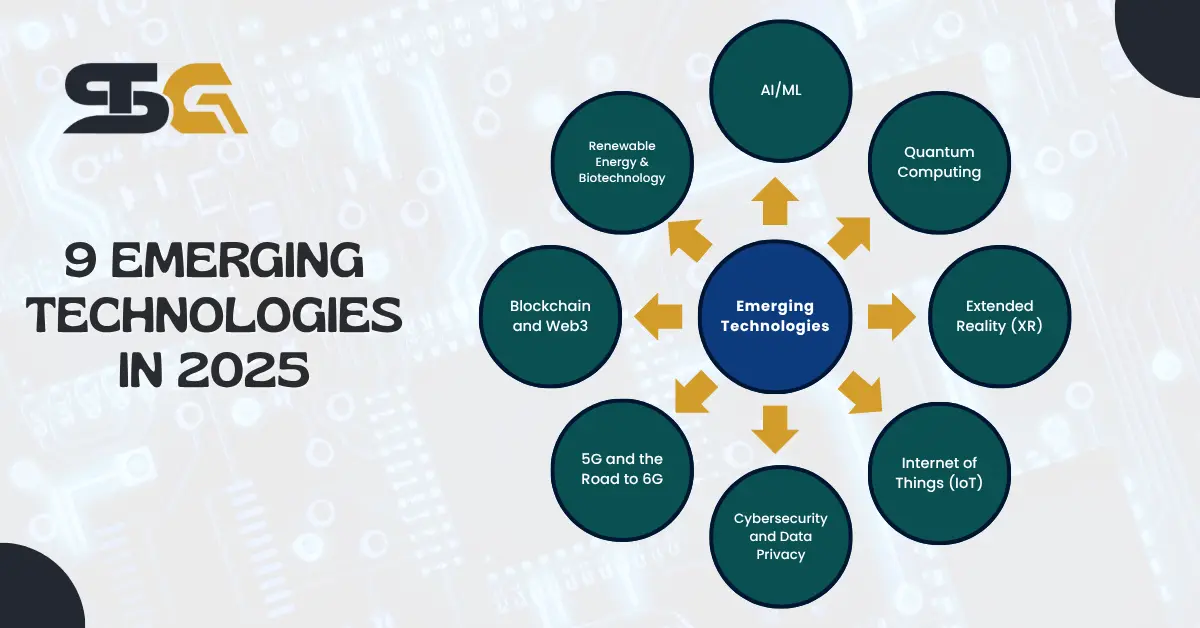
Here are the top nine emerging technologies of 2025 that are shaping our future and why they matter for you.
1. Artificial Intelligence and Machine Learning
Artificial Intelligence (AI) continues to be the most powerful technology trend in 2025. What began as automation has evolved into intelligent systems that can learn, adapt, and make decisions.
AI and Machine Learning (ML) are being used in almost every industry. In healthcare, AI helps detect diseases early and supports doctors in diagnosis. In finance, it improves fraud detection and investment strategies. Businesses use AI-powered chatbots, recommendation systems, and data analysis tools to personalize customer experiences.
Real-world example:
Retail brands now use AI to predict customer behavior, helping them create smarter marketing campaigns and improve product availability.
Why it matters:
AI and ML save time, reduce costs, and provide smarter insights, making organizations more efficient and competitive.
2. Quantum Computing
Quantum computing is transforming how we process data. Unlike normal computers that use bits (0 or 1), quantum computers use qubits, which can represent multiple states at once. This means they can perform complex calculations far faster than traditional systems.
Industries leading in adoption:
Pharmaceuticals use quantum computing for drug discovery. Banks apply it to risk management. Governments explore it for national security.
Real-world example:
Companies like IBM and Google are building quantum processors that can solve mathematical problems once thought impossible.
Why it matters:
Quantum computing will drive the next generation of breakthroughs in science, cybersecurity, and artificial intelligence.
3. Extended Reality (XR)
Extended Reality (XR) includes Virtual Reality (VR), Augmented Reality (AR), and Mixed Reality (MR). Together, they create immersive experiences that blend the digital and physical worlds.
- In education, XR enables virtual classrooms where students can explore historical events or human anatomy in 3D.
- In business, it helps teams train safely in simulated environments.
- In entertainment, it allows users to experience games and movies more realistically.
Real-world example:
Companies use AR tools for interactive product demos, allowing customers to visualize how items fit into their homes before buying.
Why it matters:
XR is changing how we learn, work, and interact by creating more engaging and realistic digital experiences.
4. Internet of Things (IoT)
The Internet of Things connects billions of devices around the world, from smart speakers to industrial sensors. These devices share data that help people and organizations make smarter decisions.
- Smart homes use IoT to control lighting, temperature, and security systems automatically.
- Smart factories use connected sensors to monitor machines and predict maintenance needs.
- Smart cities use IoT networks to manage energy use, reduce waste, and improve traffic flow.
Real-world example:
Agriculture is now powered by IoT sensors that monitor soil conditions and water levels, improving crop production and reducing resource waste.
Why it matters:
IoT enhances efficiency, safety, and sustainability by connecting the digital and physical worlds.
5. Cybersecurity and Data Privacy
As digital systems grow, protecting them becomes more complex. Cybersecurity is now a top priority for every organization.
Emerging security technologies in 2025 include AI-based threat detection, blockchain authentication, and quantum-safe encryption. These tools help businesses prevent attacks before they happen and protect sensitive data from breaches.
Real-world example:
Large companies use predictive AI security platforms that identify potential risks and respond automatically, minimizing damage.
Why it matters:
In a data-driven world, strong cybersecurity ensures trust, privacy, and resilience against digital threats.
6. 5G and the Road to 6G
5G networks are already transforming communication by providing ultra-fast internet speeds and minimal delay. But 6G, which is in early research, promises even greater possibilities.
With 5G, technologies such as autonomous vehicles, smart factories, and remote surgeries have become feasible. 6G will bring higher capacity, near-zero latency, and improved global connectivity.
Dive deeper: 5G and 6G
Real-world example:
Factories use 5G to connect robotic systems and sensors that work together in real time, boosting productivity.
Why it matters:
Next-generation connectivity will create new opportunities for automation, telemedicine, and immersive communication.
7. Blockchain and Web3

Blockchain is changing how data and transactions are managed online. It provides transparency, traceability, and security without needing central control.
Web3, the next evolution of the internet, builds on blockchain by giving users more control over their digital identity, assets, and privacy.
Real-world example:
Businesses use blockchain to track products in their supply chain, ensuring authenticity and reducing fraud.
Why it matters:
Blockchain is creating a more transparent and trustworthy digital economy where users, not corporations, control the data.
8. Renewable Energy and Green Technology
Climate change and sustainability are pushing innovation in renewable energy. Solar power, wind energy, green hydrogen, and smart grids are leading the transformation toward cleaner energy systems.
AI and IoT are being used to manage energy distribution, reduce waste, and improve storage. Companies are also investing in eco-friendly batteries and carbon capture technologies.
Real-world example:
Electric vehicle companies use renewable energy sources and smart charging systems to create zero-emission transportation.
Why it matters:
Green technology is essential for building a sustainable future and reducing our environmental impact.
9. Biotechnology and Digital Healthcare
Healthcare is one of the biggest beneficiaries of technological progress. Biotechnology and digital health tools are improving diagnosis, treatment, and prevention.
Innovations in 2025 include:
- AI-assisted medical imaging
- Gene editing tools like CRISPR
- Personalized medicine based on DNA analysis
- Remote patient monitoring using wearable devices
Real-world example:
Wearable sensors track heart rate, oxygen levels, and sleep patterns, alerting doctors to potential health issues instantly.
Why it matters:
Emerging healthcare technologies are improving patient outcomes, lowering costs, and increasing access to medical services.
Frequently Asked Questions (FAQs)
1. What are the top emerging technologies in 2025?
AI, quantum computing, XR, IoT, blockchain, green energy, and biotechnology are among the most impactful trends.
2. How are these technologies changing businesses?
They automate operations, enhance data insights, and improve customer experiences while lowering costs.
3. Which industries will benefit the most?
Healthcare, education, manufacturing, and finance are the main industries leading in digital transformation.
4. What skills are important for the future?
AI, data analytics, cybersecurity, and cloud computing will be key skills for the workforce of the future.
Conclusion
Technology in 2025 is not just about faster devices or smarter apps. It is about creating systems that make life easier, safer, and more sustainable. These emerging technologies are shaping a world where intelligence, connectivity, and innovation work together to solve real problems.
By learning about these trends and adapting early, individuals and businesses can stay ahead and become part of the digital revolution shaping tomorrow.